

GEO vs SEO: What Contractors Need to Know in 2026
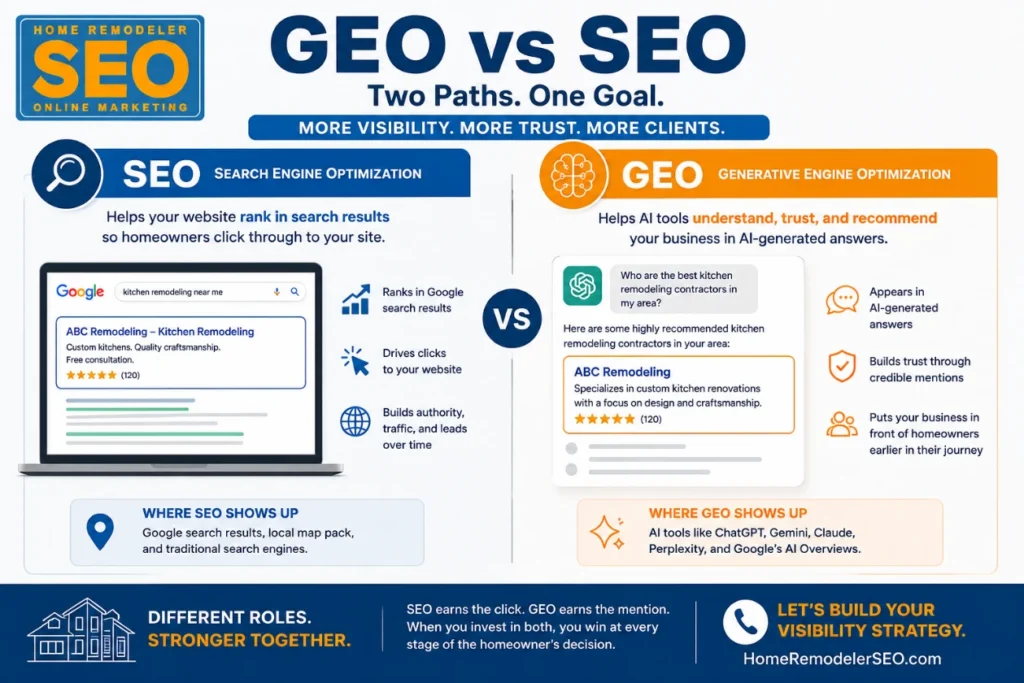
A remodeling company ranks near the top of Google for "kitchen remodeling near me," yet when a homeowner asks ChatGPT to recommend a contractor in the same area, that company never comes up. That gap is why GEO for contractors has become part of the conversation alongside traditional SEO. Generative Engine Optimization, or GEO, is the practice of shaping a website so AI systems like ChatGPT, Gemini, Claude, and Google's AI Overviews are more likely to reference, summarize, and recommend it. SEO and GEO are not competing strategies. They are two related disciplines that reward some of the same fundamentals in different ways, and understanding both is quickly becoming part of running a visible contracting business.
What Is GEO, and How Is It Different From SEO?
Traditional SEO focuses on ranking a webpage in search results so a homeowner clicks through and lands on the site. GEO focuses on something slightly different: becoming the source an AI system trusts enough to reference when it builds an answer, whether or not the homeowner ever clicks a link. A search engine sends traffic to a page. A generative engine often answers the question directly and only names a business in passing.
That distinction matters for contractors because a homeowner might ask an AI assistant "who does bathroom remodels in my area" and get a short list of names with no links at all. Ranking well in Google does not automatically mean showing up in that list. AI systems evaluate authority differently, drawing from a wider mix of reviews, mentions, and structured information across the web rather than a single ranked page.
Where SEO measures success through rankings, clicks, and traffic, GEO tends to measure success through mentions, citations, and how a business gets described inside an AI-generated answer. A contractor could technically rank on page one of Google for a service and still never get named when a homeowner asks an AI assistant the same question in conversational form, since the systems are pulling from different signals to build their response.
Is GEO Going to Replace SEO?
No, and every credible source covering this shift agrees on that point. GEO builds on the same foundation SEO already requires: a technically sound website, accurate business information, and content that demonstrates real expertise. What changes is the destination. SEO earns a spot in search results. GEO earns a mention inside an AI-generated answer. A contractor who ignores SEO fundamentals will struggle in both environments, since AI systems still rely heavily on well-indexed, well-structured websites as source material.
Should Contractors Switch From SEO to GEO?
Contractors should not switch from SEO to GEO. They should build on SEO with strategies that prepare their business for AI-driven discovery.
SEO helps homeowners find your business.
GEO helps AI systems understand why your business may be relevant.
Someone comparing five contractors by name is often searching Google directly. Someone just starting to explore an idea, like whether to remodel a kitchen or an entire main floor, may ask an AI assistant a broader question first. A contractor who only invests in traditional SEO risks being invisible during that early, exploratory stage. A contractor who only chases AI mentions risks losing the homeowners who are ready to compare specific companies by name. Treating GEO as an addition to SEO, not a replacement, protects visibility across both stages of the decision-making journey.
How Do AI Search Engines Rank Local Businesses?
AI systems lean on many of the same local signals that have always mattered: consistent business information, genuine customer reviews, a well-maintained Google Business Profile, and mentions across other credible sites like local directories, associations, or news coverage. What is different is the emphasis on consistency and context. If a contractor's business name, service area, and hours differ across their website, directory listings, and review platforms, that inconsistency makes it harder for an AI system to confidently include the business in a summarized answer. Detailed service pages and project write-ups add further context, giving these systems more to work with than a homeowner's review alone.
For a roofer or remodeler working across several nearby towns rather than a single city, this consistency becomes even more important. Listing every service area clearly and using the same wording across a website, Google Business Profile, and directory listings helps AI systems understand exactly where a business operates, instead of guessing based on an outdated or incomplete address.
How Do You Track AI Search Visibility?
A handful of tools now exist specifically to monitor how often a business shows up in AI-generated answers, including Semrush's AI visibility checker, Ahrefs' AI visibility checker, and platforms like Otterly that track mentions across ChatGPT, Perplexity, Gemini, and Google's AI features. These tools typically run a set of real search-style questions against multiple AI systems, then report whether a business was mentioned, how it was described, and which competitors showed up instead. Some also track sentiment, noting whether an AI system describes a business positively, neutrally, or with outdated information that needs correcting somewhere on the web.
For a contractor just getting started, even a manual check, asking ChatGPT or Gemini a few realistic homeowner questions about local services, offers a useful early signal of where the business currently stands. Running the same handful of questions every few weeks and noting whether the business appears, and how it is described, can reveal patterns long before investing in a dedicated monitoring tool.
Can ChatGPT Recommend My Contracting Business?
Yes, when ChatGPT's search-enabled responses pull from current web content, it can name specific businesses and link to sources it references, similar to how Google's AI Overviews work. Whether a specific contractor gets mentioned depends on the same kind of signals AI systems look for elsewhere: clear service pages, credible reviews, and consistent business details across the web. There is no way to pay for or request a mention. The most reliable path is the same one that supports every other channel, building a website and online presence that clearly explains who the business serves and how.

Frequently Asked Questions
Is GEO better than SEO? Neither replaces the other, so the question is not really which one is better. SEO earns visibility in traditional search results, while GEO earns a mention inside AI-generated answers. Contractors who invest in both tend to stay visible regardless of which method a homeowner uses to search.
Is SEO no longer relevant? SEO remains relevant because GEO depends on many of the same fundamentals, including a technically sound site, clear content, and credible business information. AI systems draw heavily from well-indexed, well-organized websites, so neglecting SEO would weaken GEO efforts too.
Is SEO still worth investing in? Yes. A homeowner comparing specific contractors by name is still searching Google directly in many cases, and a strong organic presence continues to drive that traffic. SEO also builds the foundation of accurate, structured content that AI systems rely on when generating answers.
A Clear Next Step
GEO is still a developing discipline, and the contractors adapting well are not chasing every new acronym. They are strengthening the same things that have always mattered: clear service pages, genuine reviews, and consistent business information across the web.
Home Remodeler SEO helps contractors build stronger digital foundations through strategies designed around visibility, credibility, and long-term growth.
If you are unsure whether your current website is prepared for AI-driven search, a conversation can help identify opportunities to strengthen your online presence and connect with more qualified homeowners.


