

What Google AI Overviews Mean for Contractor SEO in 2026
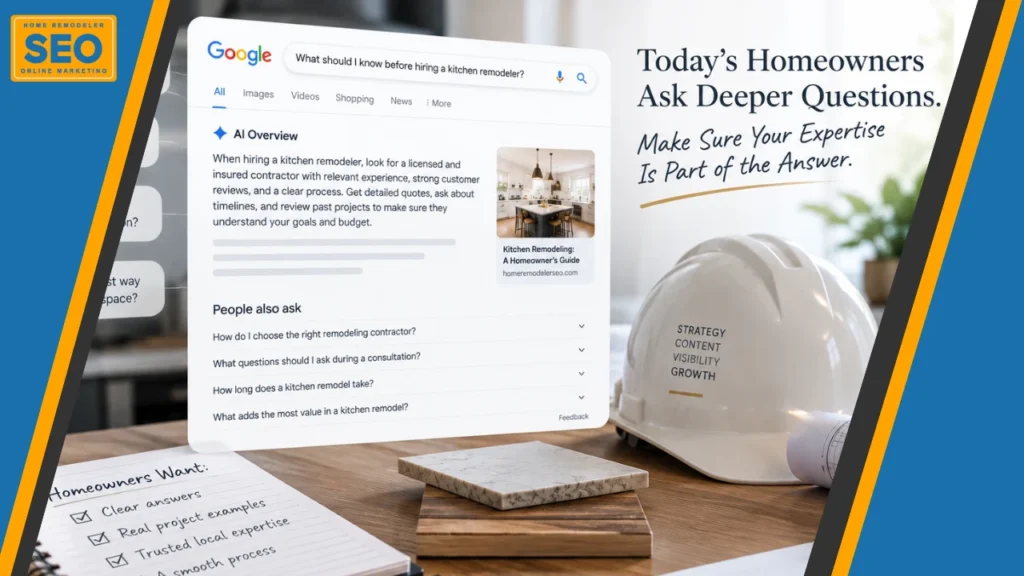
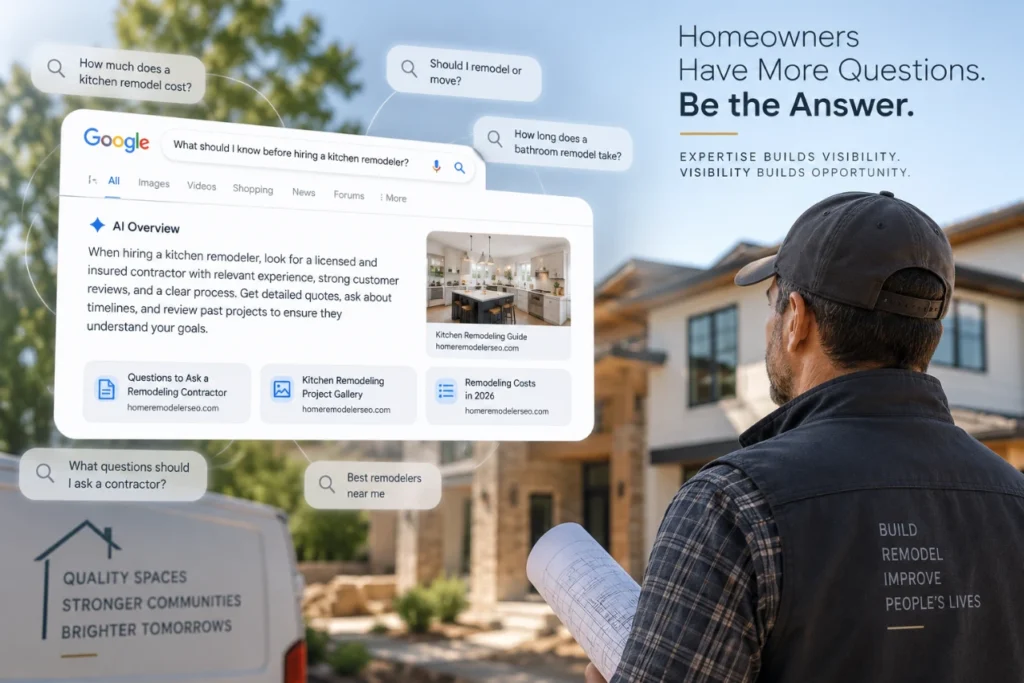
A homeowner planning a remodel may now ask Google, “What should I know before hiring a kitchen remodeler?” and receive an AI-generated summary before scrolling through traditional results. Google AI Overviews for contractors are changing how information gets presented, but they do not make traditional SEO obsolete.
For contractors, the practical response remains familiar: publish genuinely useful content, maintain a technically accessible website, demonstrate real experience, and keep business information accurate. Google says its generative AI search experiences rely on its existing Search ranking and quality systems, with no separate technical requirements for appearing in AI Overviews or AI Mode.
The opportunity is not to rebuild your entire marketing strategy around AI. It is to make the expertise already inside your company easier for homeowners and search systems to understand.
What Are Google AI Overviews?
Google AI Overviews are AI-generated responses that can appear when Google determines a summary would help someone understand a topic. They may include links to websites where searchers can explore information in greater depth.
They do not appear for every search.
A homeowner searching “roofer near me” may encounter a different experience from someone asking, “Should I replace my roof before installing solar panels?” The second query requires explanation, creating more opportunity for useful educational content to become part of the search journey.
Contractors should also avoid treating an AI mention like a permanent ranking position. The sources and responses Google surfaces can change depending on the query and context.
Google AI Overviews for Contractors Still Depend on Strong SEO
One misconception about AI Overviews SEO is that contractors now need an entirely separate optimization formula.
Google's guidance says otherwise. A page needs to be indexed and eligible to appear in regular Google Search before it can qualify as a supporting link in AI Overviews or AI Mode. Google also says there are no additional technical requirements or special AI schema needed for these features.
That makes foundational contractor SEO in 2026 just as relevant.
Contractors still need crawlable pages, useful internal links, strong page experience, accurate business information, and structured data that correctly represents visible website content.
This matters because chasing AI-specific tactics while neglecting basic SEO solves the wrong problem. If Google struggles to crawl, understand, or trust your website, adding more AI-focused content will not fix the underlying weakness.
Real Contractor Expertise Gives AI Search Something Useful to Surface
AI may change how search results look, but it cannot create meaningful contractor expertise that is missing from a website.
Consider two whole-home remodeling pages.
One promises “high-quality renovations tailored to your vision.” Another explains when whole-home remodeling makes more sense than renovating room by room, how design decisions affect construction sequencing, and which issues commonly change project schedules.
The second page gives homeowners information they can actually use.
Google's current guidance encourages original, people-first content that adds value rather than repeating information already available elsewhere. Contractors have a natural source for that material: their own experience.
Questions from sales calls, complicated projects, material decisions, permitting challenges, homeowner concerns, and lessons learned in the field can all become useful content.
That is where a human-led approach matters. AI can assist with organizing information, but your actual experience gives the content credibility.
Project Pages Can Turn Experience Into Searchable Evidence
Many contractors have some of their strongest marketing material sitting in project folders.
Beautiful photographs demonstrate craftsmanship. Detailed project stories demonstrate expertise.
Suppose a remodeler transformed a closed-off kitchen for a family that entertains frequently. Instead of uploading six finished photographs and moving on, the project page could explain the original layout problem, structural considerations, storage decisions, material selections, and reasoning behind the finished design.
That information helps homeowners determine whether the contractor has solved problems similar to theirs.
It also gives Google AI search more original context about the company's actual work. Google recommends supporting useful written information with quality images and video when those formats improve the experience.
For contractors, the takeaway is straightforward: document the thinking behind the finished work, not only the finished work.
Local SEO and AI Should Reinforce the Same Business Information
Search may be becoming more conversational, but contractors still work in specific markets.
That makes local SEO and AI complementary strategies.
Google says local results primarily consider relevance, distance, and prominence. Complete Business Profile information, reviews, links, accurate service details, and other signals help Google understand a local business.
A remodeler serving multiple communities should therefore do more than repeat city names across its website.
Real local evidence carries more meaning. Project pages can identify where work occurred when appropriate. Location pages can explain services and considerations relevant to that market. The website and Google Business Profile should also agree on core business information.
A contractor's digital footprint becomes easier to understand when those signals consistently describe the same company, services, and markets.
AI Search Makes Specific Contractor Content More Valuable
Contractor websites often rely on language that could belong to almost anyone.
“Quality craftsmanship.” “Exceptional service.” “We bring your vision to life.”
Those phrases sound polished but give homeowners little information for comparing companies.
AI search for remodelers gives contractors another reason to become more specific. Explain whether you specialize in full-home projects or smaller renovations. Describe your preconstruction process. Explain how selections are managed. Show completed projects that support those claims.
This does not mean writing for machines.
The better question is: What does a qualified homeowner need to understand before deciding whether we're the right contractor?
Answering that question creates useful content for people first while giving search systems clearer information about your expertise.
AI Visibility Should Be Measured Against Qualified Opportunities
Contractors understandably want to know whether AI Overviews will increase or decrease website traffic. That question is worth monitoring, but traffic alone does not tell the entire story.
Some searches may end after an AI-generated answer. Others may introduce homeowners to companies or resources they would not otherwise have discovered.
The better business question is whether search produces qualified opportunities.
A remodeling company could receive fewer casual visits while attracting more homeowners who understand its services, review several projects, and eventually schedule consultations.
Contractors should therefore evaluate search visibility alongside website engagement, calls, forms, booked appointments, and lead quality. Marketing should support the sales pipeline, not simply produce impressive traffic charts.
Frequently Asked Questions
Can contractors pay to appear in Google AI Overviews?
Contractors cannot purchase an organic placement that guarantees inclusion in an AI Overview. Google determines supporting sources through its Search systems, and meeting technical requirements does not guarantee that a particular page will appear.
Do contractors need special schema for AI Overviews?
No. Google says there is no special structured data required specifically for AI Overviews or AI Mode. Existing schema should accurately represent information that users can see on the website.
Is traditional contractor SEO still worth investing in?
Yes. Google's guidance indicates that established SEO practices remain relevant to its generative AI search experiences. Technical accessibility, useful original content, internal linking, accurate business information, and a strong website foundation continue to matter.
Can smaller remodeling companies appear in AI search?
Google does not publish a company-size requirement for appearing in its AI search experiences. Smaller contractors can still strengthen their eligibility and broader search presence through original expertise, detailed projects, technically accessible pages, and accurate business information, although no individual AI mention can be guaranteed.
Make Your Real-World Expertise Easier to Find
Contractors do not need to choose between traditional SEO and AI search. The stronger approach is building a digital presence that gives homeowners and search systems clear evidence of who you are, what you do, where you work, and what you know.
That means Google AI Overviews for contractors should prompt a better question than “How do we optimize for AI?” Look at whether your service pages genuinely answer homeowner questions, your project content demonstrates real experience, your local information is consistent, and your website gives qualified prospects enough confidence to continue the conversation.
Home Remodeler SEO helps contractors connect those pieces into a search strategy built around credibility and qualified opportunities. If your team has years of project knowledge that barely appears online, a conversation with HRS can help identify which real homeowner questions, project experiences, and service insights deserve a stronger place in your website and search strategy.


