

How AI Decides Which Contractors to Recommend
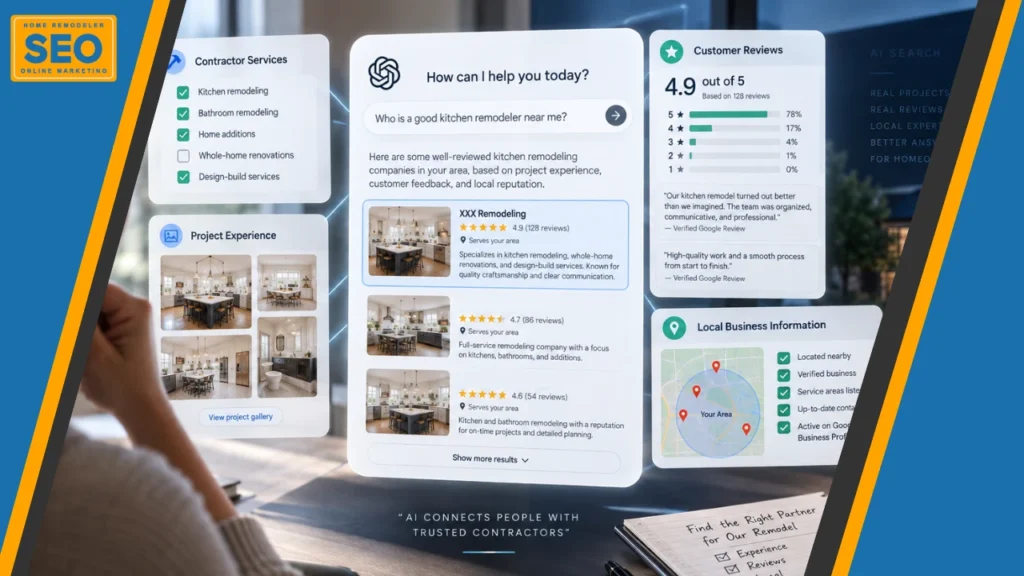
A homeowner asks Google, ChatGPT, or another AI-powered search tool, “Who is a good kitchen remodeler near me?” Within seconds, they may receive a summarized answer, supporting sources, or businesses worth investigating.
So, how AI recommends contractors is becoming a practical marketing question. There is no single universal formula or published “AI score.” Different platforms use different systems, but guidance from Google and OpenAI points toward a familiar foundation: relevant and accessible information, useful content, reliable sources, and enough context to understand whether a business fits the searcher's needs.
For contractors, AI visibility is less about chasing a new algorithm and more about making real expertise easier to find, understand, and verify.
How AI Recommendations Actually Work
AI recommendations depend heavily on what the homeowner asks.
“Who remodels luxury kitchens?” is different from “Who builds home additions near me?” Add location, project type, style, or other requirements, and the information needed to provide a useful response changes again.
OpenAI explains that ChatGPT Search can rewrite questions into more targeted searches and use general location information when relevant. Search results are ranked using multiple factors designed to surface relevant and reliable information, but OpenAI does not guarantee placement.
Google likewise says its Search systems evaluate many factors, including the meaning of a query, relevance, usability, source expertise, and location.
That is why contractors should be cautious about claims that one tactic controls AI search rankings. There is no published checklist that guarantees an AI recommendation.
A better objective is to make your company a credible, well-supported answer when the right homeowner asks the right question.
Clear Information Helps AI Understand What Your Company Does
Many contractor websites make their expertise harder to understand than necessary.
“We create beautiful spaces designed around your lifestyle” might sound appealing, but it does not tell a search system whether the company builds custom homes, remodels kitchens, handles additions, or provides roofing.
Specific language creates useful context.
A remodeler could explain that it specializes in whole-home remodeling and additions involving structural changes, layout improvements, and coordinated design and construction. A roofer could clearly distinguish residential roof replacement from commercial roofing services.
Google's guidance for its generative AI search experiences continues to emphasize useful, original content alongside established SEO practices. Google also says its AI Search features rely on core Search ranking and quality systems.
This is where contractor GEO fits into the larger strategy. Generative Engine Optimization, or GEO, means making information easier for generative AI systems to find and understand. It should complement strong SEO rather than replace it.
Real Projects and Helpful Content Provide Evidence of Expertise
Contractors already possess something generic marketing content cannot manufacture: completed work and the knowledge gained from delivering it.
Imagine two remodelers that both claim extensive whole-home remodeling experience.
One publishes a gallery of finished photographs. The other explains what homeowners wanted, problems with the original layout, important design decisions, construction challenges, and how the finished project addressed those issues.
The second company gives homeowners more evidence behind its claim.
Project pages can document why a particular roofing system suited a property, how a difficult building site affected a custom home, or how a remodeler improved an outdated floor plan.
Educational content can do something similar.
Think about the questions your team answers during consultations. When should a homeowner involve an architect? What happens during preconstruction? Which selections need to happen before work begins? How should someone compare remodeling proposals?
Those questions can become useful website resources.
Google's generative AI guidance encourages unique, non-commodity content that provides real value. It also explains that generative Search experiences can use retrieval-augmented generation, or RAG. In simple terms, RAG allows an AI system to retrieve relevant information from Google's Search index to help produce a response.
Your real project knowledge gives those systems something substantive to retrieve while helping homeowners make better decisions.
Reviews and Local Signals Add Important Credibility
Your website explains what your company promises. Customer reviews describe what people experienced.
Google explicitly says review count and positive ratings can contribute to local prominence, one of the factors it uses for local rankings alongside relevance and distance.
That does not mean a certain number of reviews will produce AI recommendations.
Reviews are valuable because they provide another layer of evidence. When customers repeatedly mention communication, project management, craftsmanship, cleanliness, or problem-solving, those experiences can reinforce claims made elsewhere in your digital presence.
Location matters too.
A homeowner does not simply need a capable remodeler. They need one that actually serves their community.
Google recommends maintaining complete and accurate Business Profile information to help it understand local businesses. Contractors should clearly communicate service areas, keep core business details current, and use project or location pages to demonstrate genuine market experience when appropriate.
Avoid creating dozens of nearly identical pages that simply swap city names. Useful local content should tell homeowners something meaningful about your services or experience in that market.
Consistency Across Your Digital Footprint Reduces Confusion
Imagine your website lists one set of services, your Google Business Profile suggests another, and an old directory promotes work you stopped offering years ago.
A homeowner would struggle to know which information is accurate.
Search systems can encounter the same problem.
Google says local business information can come from official websites, third-party data, user contributions, and Google's own interactions with businesses and places.
That makes basic digital housekeeping part of an AI-ready strategy.
Keep service descriptions current. Maintain accurate contact and business information. Update your Google Business Profile. Review important online profiles for outdated services or locations.
Consistency does not guarantee inclusion in an AI answer. It simply makes the facts about your company easier to establish.
And that is the larger principle: AI cannot confidently interpret information that your own digital presence communicates inconsistently.
What About ChatGPT Contractor Recommendations?
Contractors are understandably interested in appearing when homeowners ask ChatGPT for recommendations.
There are practical technical considerations.
OpenAI states that a website must allow OAI-SearchBot to crawl it to be eligible for inclusion in ChatGPT Search results. OpenAI also says search results are ranked using multiple factors intended to surface relevant and reliable information, and placement is not guaranteed.
That distinction matters.
ChatGPT contractor recommendations should not be treated like a traditional directory where a company submits its information and secures a fixed position. The answer can depend on the homeowner's question, available web information, location context, and sources retrieved during the search.
Contractors should also avoid building their entire marketing strategy around one AI platform.
Google, ChatGPT, and other search experiences will continue evolving. Clear service pages, authentic reviews, detailed projects, accurate local information, helpful educational content, and a technically accessible website provide a stronger foundation regardless of which interface homeowners use.

Frequently Asked Questions About AI Contractor Recommendations
Can contractors pay ChatGPT to recommend their company?
Contractors cannot purchase organic ChatGPT Search placement that guarantees a recommendation. OpenAI states that search placement is not guaranteed.
Does publishing more content improve AI visibility?
Not automatically. One detailed resource based on genuine contractor experience may provide more value than several generic articles covering information already widely available. Quality, relevance, originality, and clarity matter more than simply increasing publishing volume.
Do Google reviews help AI recommend contractors?
Google confirms that review count and positive ratings can help local ranking, but it does not state that reviews guarantee an AI recommendation. Reviews are better viewed as part of a broader credibility system alongside website content, projects, local information, and other reputation signals.
Can smaller contractors compete for AI visibility?
Neither Google nor OpenAI publishes a minimum company-size requirement for appearing in their search experiences. Smaller contractors can still strengthen their digital presence through useful expertise, real project evidence, accurate business information, authentic reviews, and technically accessible websites.
What Would AI Find If It Researched Your Company Today?
The most useful question is not simply, “How do we get AI to recommend us?”
Ask what a homeowner or AI system would find if it tried to verify your company today. Would it find detailed projects, clear service information, useful answers, current reviews, and consistent local information? Or does most of what makes your company worth hiring still live inside sales conversations and your team's experience?
Home Remodeler SEO helps contractors close that gap. If your company has years of expertise but only a fraction of it is visible online, a conversation with HRS can help identify which project knowledge, homeowner questions, local signals, and credibility gaps deserve attention first. That gives you a clearer roadmap for strengthening visibility across traditional search and emerging AI experiences without losing sight of the homeowners you ultimately need to reach.


