

Roofing Contractor SEO in 2026: What Homeowners Ask AI Before Hiring a Roofer
TL;DR: In 2026, homeowners ask AI tools like ChatGPT and Google's AI Overviews specific roofing questions before they call anyone: whether roof age will affect their insurance, whether a tax credit still applies, whether prices will keep rising, whether a FORTIFIED roof is worth it in their state, and how to spot a storm chaser. Roofers whose websites answer these questions clearly, locally and with a current date are the ones AI recommends. Good roofing contractor SEO now means publishing those answers, not just listing services.
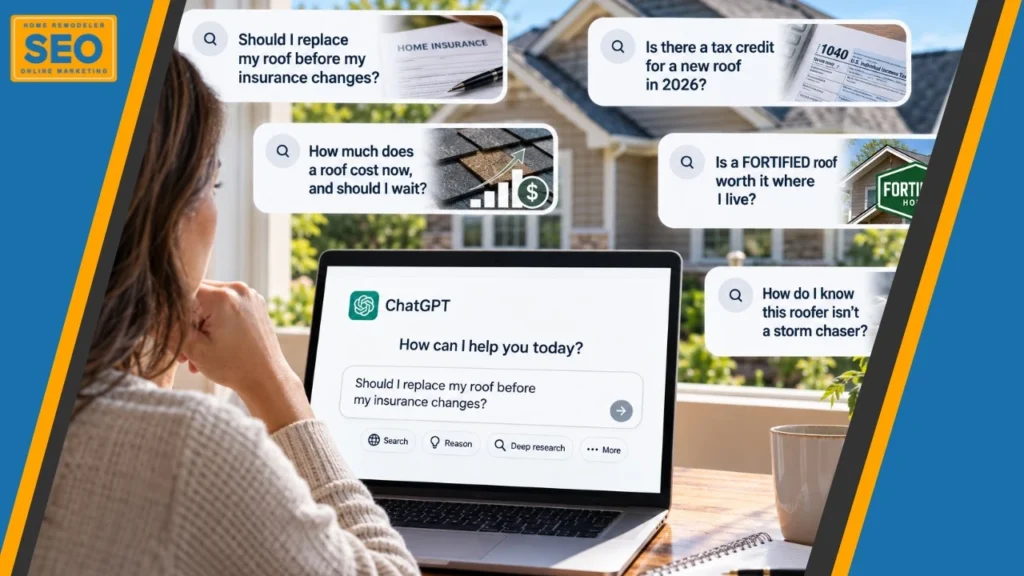
A homeowner opens her insurance renewal and finds a new line: her 16-year-old roof will now be paid at "actual cash value." She doesn't type "roofers near me." She asks ChatGPT, "Should I replace my roof before my insurance changes?" The answer explains her options and names two or three local companies.
That is roofing contractor SEO in 2026. AI tools recommend the roofers whose websites answer specific homeowner questions clearly. A site that only lists services gives AI little reason to mention you.
Below are the roofing questions homeowners are bringing to AI this fall, why each one is surfacing now, and what a roofer can publish to become the answer. We're a marketing company, not roofers, so the industry details here come from insurers, government agencies and news reports, linked throughout. Our part is showing how those questions shape what AI recommends.
Why Roofing Questions Got More Specific in 2026
Three things changed at once: insurers are rewriting how they cover roofs, material costs keep climbing, and storm-scam warnings have been in the local news all year.
Each of these creates a question a homeowner would rather ask privately before calling anyone. AI search for roofers is where those private questions now go. By AI search, we mean tools like ChatGPT, Gemini, Perplexity and Google's AI Overviews, which write a direct answer instead of showing a list of links.
The roofer whose website explains the situation in plain language becomes the source that answer is built from.
"Should I Replace My Roof Before My Insurance Changes?"
Many carriers now pay older roofs at actual cash value, meaning the depreciated value of the old roof rather than the cost of a new one. Ohio's independent insurance agents report that some carriers apply this schedule once a roof reaches 11 years, and many are adding roof-specific wind and hail deductibles set as a percentage of the home's insured value.
In Florida, an insurance expert told CBS12 in August 2026 that carriers now generally treat 15 years as the oldest shingle roof they want to insure.
What to publish: a page that explains how roof age affects coverage in your state, what a roof inspection documents, and when replacement makes sense and when it doesn't. You're not giving insurance advice; you're helping homeowners know what to ask their agent
"Is There a Tax Credit for a New Roof in 2026?"
At the federal level, no. According to the IRS, the Energy Efficient Home Improvement Credit, known as 25C, does not apply to improvements made after December 31, 2025.
Yet plenty of roofing websites still promise a "roof tax credit." Homeowners notice when a contractor's information is wrong, and AI tools favor sources that are accurate and current.
What to publish: a short, dated answer that corrects the myth, then points homeowners toward state, city or utility programs worth checking. Correcting a common mistake is one of the fastest ways to earn trust before the first phone call.
"How Much Does a Roof Cost Now, and Should I Wait?"
Price questions have changed tone this year. Homeowners aren't just asking what a roof costs; they're asking whether waiting will cost them more. Roofers in Tampa told Bay News 9 in late September that tariffs, fuel costs and energy prices are pushing material costs up.
This connects to a broader pattern we've written about: homeowners are taking longer to say yes, and they research more before reaching out.
What to publish: you don't need to post a price list. Explain what drives roof cost in your area, how material choices change the budget, and whether fall and winter installs work in your climate. A homeowner who understands the "why" behind a quote is a better-fit lead when they call.
"Is a FORTIFIED Roof Worth It Where I Live?"
FORTIFIED is a roofing standard from the Insurance Institute for Business & Home Safety (IBHS), an insurance-industry research group. Homes earn the designation after an independent evaluator confirms the roof was built to the standard's storm-resistance requirements.
The answer depends heavily on location. Louisiana insurers are required to give discounts for FORTIFIED roofs, and Alabama homeowners can save 25 to 40 percent on the storm portion of their premium. Connecticut, by contrast, promotes the standard without a required discount.
What to publish: a page that answers this question for your state specifically. National websites can't do that well. If your crew is certified, say so plainly on your site, your Google Business Profile and your directory listings, so AI tools see the same fact everywhere.
"How Do I Know This Roofer Isn't a Storm Chaser?"
A storm chaser is an out-of-town crew that follows severe weather, sells repairs door to door, and is often gone before problems show up. Warnings this year have been specific. Police in Minnesota warned of callers claiming to be on their way to inspect storm damage nobody had reported, and the Kansas Attorney General urged homeowners to get at least three written estimates after summer hail.
When a homeowner asks AI how to vet a roofer, the answer usually reads like a checklist: a local address, a valid license, a history of reviews, a written contract. Your digital footprint has to pass that checklist consistently.
What to publish: a "how to check a roofer" page in your state's terms, plus your own license number, address and years in business shown clearly. Reviews that mention real neighborhoods and real projects carry more weight than a star rating alone. Our recent guide on reviews, reputation and AI search covers this in more depth.
What Roofing SEO Looks Like When AI Is Reading Your Site
Good roofing SEO in 2026 still rests on the basics: a fast website, strong service pages and an active Google Business Profile. What changes is how you write and organize the content.
- Use the homeowner's question as the heading, then answer it in the first one or two sentences.
- Name your state and city, along with the local rules that apply.
- Add an "Updated" date to pages where the answer changes year to year.
- Label your FAQs with structured data, code that tells search engines and AI tools a section is a question and answer.
- Keep your name, address, phone and license identical across your website, Google Business Profile and directories.
None of this replaces traditional SEO. It works alongside it, and it builds on the same trust signals we explained in how AI decides which contractors to recommend.
Frequently Asked Questions
Do roofing companies still need traditional SEO if homeowners use AI?
Yes. AI tools draw heavily on the same websites, reviews and business listings that rank in regular search. Strong roofing SEO gives AI accurate material to work with.
Which roofing questions should my website answer first?
Start with the question causing the most stress in your market. For most roofers in 2026, that's roof age and insurance. Then cover cost, scam prevention and any storm-resistance programs in your state.
How often should roofing content be updated?
Review it at least once a season, and immediately when an insurance rule, tax law or state program changes. A visible "Updated" date tells homeowners and AI tools the answer is current.

Become the Roofer AI Recommends
Homeowners are asking sharper roofing questions than ever, and they're making up their minds before they call. The roofers who answer clearly, locally and honestly are the ones AI keeps recommending.
If you'd like to see which of these questions your website answers today, and which ones are sending homeowners to a competitor, a short conversation with Home Remodeler SEO can map it out.


