

The best contractor marketing strategy is not a collection of ads, posts, and keywords. It is a connected system that helps the right homeowners discover your company, trust your expertise, compare their options, and feel confident taking the next step.
This contractor marketing guide explains how to connect your website, SEO, Google Maps, PPC, video, social media, community platforms, content, reputation, and lead follow-up around that decision-making journey.
AI belongs in that system, but it is not the center of it. Homeowners still make decisions based on recognizable human signals: credibility, familiarity, proof, responsiveness, and confidence that a contractor understands their project.
Start With Revenue, Capacity, and the Projects You Want
Before selecting channels, define the business outcome marketing needs to produce.
A design-build company looking for three $500,000 renovations needs a different strategy from a roofing contractor that must complete several projects each week. Your marketing plan should reflect:
- Priority and most profitable services
- Minimum project size
- Geographic service area
- Production capacity
- Average sales cycle
- Consultation and closing rates
- Revenue target
- Number of projects required to reach that target
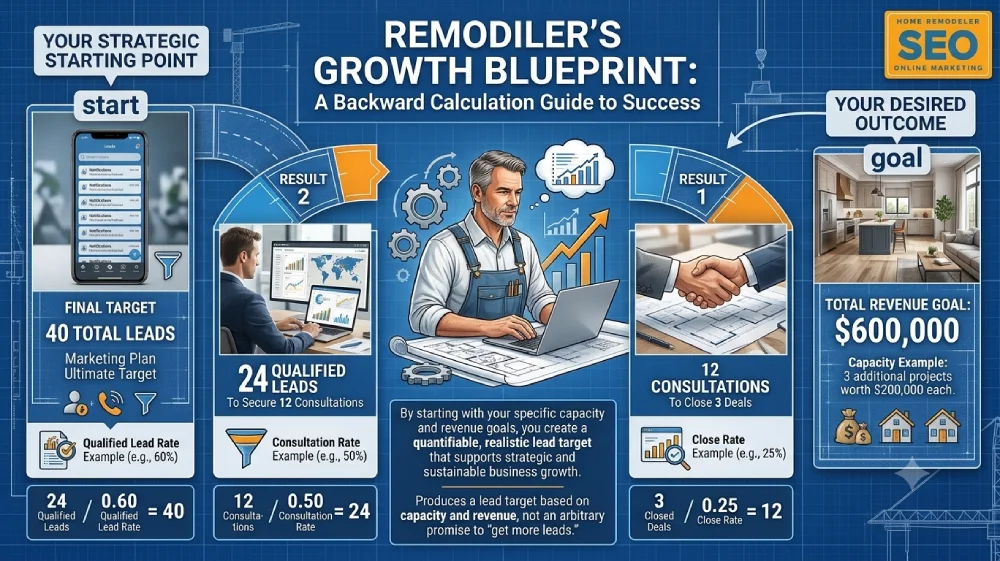
This changes how marketing performance gets evaluated. A channel that produces ten strong opportunities may be more valuable than one producing 100 poorly matched inquiries.
Content Marketing Institute found that 82% of top-performing B2B marketers credited audience understanding as a major contributor to their success. The same principle applies to contractors: understand the homeowner and project you want before deciding where to invest.
Understand How Homeowners Actually Choose Contractors
The contractor buyer’s journey is the process a homeowner follows from recognizing a need to hiring a company. It rarely follows a clean, predictable path.
Someone might discover a contractor on Google Maps, watch two project videos, read reviews, ask for opinions in a neighborhood Facebook group, visit the website again, and then wait several weeks before making contact.
During that process, homeowners move between two mental activities:
- Exploration: Gathering ideas, companies, prices, and possible solutions
- Evaluation: Narrowing those choices by comparing proof, risk, fit, and credibility
Think with Google describes this cycle as the “messy middle” of decision-making. People move repeatedly between exploration and evaluation before choosing.
Contractor marketing should therefore answer three psychological questions:
- Can this company handle my type of project?
- Can I trust them with my home and money?
- Will working with them feel organized and manageable?
Detailed projects, clear processes, authentic reviews, visible expertise, and consistent messaging reduce the uncertainty behind those questions.
Build a Website That Helps Homeowners Evaluate You
A contractor website should not simply introduce the company. It should help homeowners decide whether the company fits their project.
That requires:
- Dedicated pages for core services
- Accurate service-area information
- Project galleries explaining challenges, decisions, and outcomes
- Guidance about budgets, timelines, permits, and disruption
- A clear design and construction process
- Team experience and credentials
- Reviews connected to relevant services
- Calls to action that explain what happens after contact
This search-friendly structure supports SEO for remodeling companies, but its real value is psychological. Specificity lowers perceived risk. When a homeowner sees a project similar to theirs, understands the next step, and recognizes the company’s standards, contacting that contractor feels safer.
Use Search, Google Maps, and PPC to Capture Active Demand
SEO, Google Maps, and pay-per-click advertising reach homeowners who are already expressing interest.
Organic SEO builds long-term visibility through technically sound pages, useful content, local relevance, internal links, and external authority. Google Maps supports local discovery through the contractor’s Google Business Profile, reviews, photos, services, and business information.
BrightLocal found that 20% of consumers default to map platforms for local searches, while 67% often or always read reviews after conducting a local search.
PPC, or pay-per-click advertising, allows a company to pay for visibility when someone searches relevant terms. Google Ads Help confirms that Search campaigns can reach people actively looking for specific services.
Each channel plays a different role:
- SEO builds visibility and authority over time.
- Google Maps helps homeowners discover and verify local contractors.
- PPC creates immediate visibility for high-intent searches.
- Retargeting keeps the company recognizable during a longer decision cycle.
Paid traffic should lead to a page that matches the search and provides enough proof to support the next decision.
Use YouTube and Social Media to Make Expertise Visible
Homeowners cannot inspect workmanship through a search result. Video helps close that gap.
Contractors can use YouTube and short-form video to explain:
- How the company plans a project
- Why certain materials were recommended
- What happened behind the finished walls
- How a difficult site condition was addressed
- What homeowners should expect during construction
- How before-and-after transformations were achieved
A polished commercial is not always necessary. A knowledgeable project manager explaining a real job may build more trust because the homeowner can see how the company thinks.
Longer YouTube videos can support research and evaluation. Shorter clips on Facebook, Instagram, or LinkedIn build familiarity and keep the company visible between website visits. Think with Google’s guidance treats YouTube as capable of supporting awareness, consideration, and conversion goals across the funnel.
Participate in Reddit and Local Communities With Care
Reddit, Nextdoor, Facebook groups, and neighborhood forums reveal the questions homeowners ask when contractors are not in the room.
People discuss costs, warning signs, material choices, permit concerns, delays, and previous experiences. These conversations can help contractors understand homeowner language and identify topics their websites should address.
The right approach is participation, not disguised promotion:
- Answer questions when you have genuine expertise.
- Disclose your professional connection to the industry.
- Avoid turning every response into a sales pitch.
- Study repeated concerns to improve content and sales conversations.
- Follow each community’s rules before posting.
These platforms may not generate immediate leads every week. Their value also comes from research, local recognition, referrals, and trust built through useful participation.
Build a Content Strategy Instead of Filling a Calendar
Content should have a job. Before publishing, establish four things.
Define the audience and outcome. Identify the project, homeowner concern, and action the content should support.
Choose formats and channels. A structural explanation may need a blog and YouTube video. A transformation may work better as a project story, Google Business Profile post, and social video.
Create a sustainable cadence. One useful project story each month is more valuable than a daily schedule the team cannot maintain.
Plan distribution before publishing. A blog should not remain isolated on the website. Adapt it for email, video, social media, sales follow-up, Google Maps, and relevant community discussions.
One completed project can become a detailed case study, homeowner FAQ, short video, email, review request, social series, and sales resource. This makes digital marketing for contractors more efficient while preserving real experience.
Keep AI in Its Proper Role
AI can help contractors organize interviews, identify recurring questions, summarize performance, develop outlines, and adapt original material for different platforms.
It should not replace the contractor’s judgment, stories, or expertise.
Google Search Central says established SEO fundamentals still apply to AI Overviews and AI Mode. Clear structure, original information, accurate business details, crawlable pages, and people-first content remain the foundation.
For contractors, AI readiness means:
- Answering important questions directly
- Using descriptive headings
- Defining services clearly
- Adding specific project facts
- Keeping business listings accurate
- Supporting claims with evidence
- Identifying expert authors or reviewers
- Using appropriate structured data
- Earning credible local and industry mentions
An analysis of 6.9 million local AI-search citations found that websites lead local citations, while listings and directories provide important verification signals. iPullRank
Publish First-Hand Content Competitors Cannot Easily Recreate
Generic content rarely builds trust. Instead, share real project experiences, challenges, solutions, and lessons only your team can provide. This demonstrates expertise and helps homeowners make informed decisions.
Google recommends original, experience-based, non-commodity content with clear structure and helpful visuals because it performs well in both traditional Search and AI-powered results.
A single project can be repurposed into a blog, social posts, video, FAQ, Google Business Profile update, email, and service page content, making your marketing more sustainable and effective.
Measure the Journey From Discovery to Revenue
Every lead should enter a trackable process recording its source, requested service, qualification status, response time, appointment, estimate value, sales result, and closed revenue.
Review performance at each stage:
- Visibility and reach
- Engaged website visits
- Calls and form submissions
- Qualified opportunities
- Booked consultations
- Issued estimates
- Closed projects
- Customer acquisition cost
- Revenue by source
This shows whether the problem is visibility, trust, conversion, lead quality, sales, or follow-up. More traffic will not solve a response-time problem. More leads will not solve unclear qualification standards.
Build a Marketing System Worth Investing In
None of this requires a marketing department or a six-figure retainer. It requires a clear website, a well-tended review profile, and content that reflects the expertise you've built over years of real projects.
Home Remodeler SEO helps contractors find the gaps between attention and revenue. If you're weighing whether your current marketing reflects the quality of your work, that's usually worth acting on rather than sitting with. A discovery call costs 20 minutes, and it'll tell you within that time whether there's a gap between how good your work is and how well your marketing currently proves it. Either way, you'll leave with more clarity than you had going in.


