

Contractor Reviews SEO in 2026: How Reviews Shape AI Recommendations for Local Contractors
AI tools now read a contractor's reviews before homeowners do. In 2026, what matters most is how recent your reviews are, the themes they repeat, whether they appear beyond Google, how quickly you respond, and whether you collected them the right way. A steady flow of honest, recent, detailed reviews on a few trusted sites does more for contractor reviews SEO than a large total from years ago.
A remodeler with 180 Google reviews asks ChatGPT for a kitchen remodeler in their own town. A company that opened two years ago gets named instead. It happens more often than owners expect, and the total count is rarely the reason.
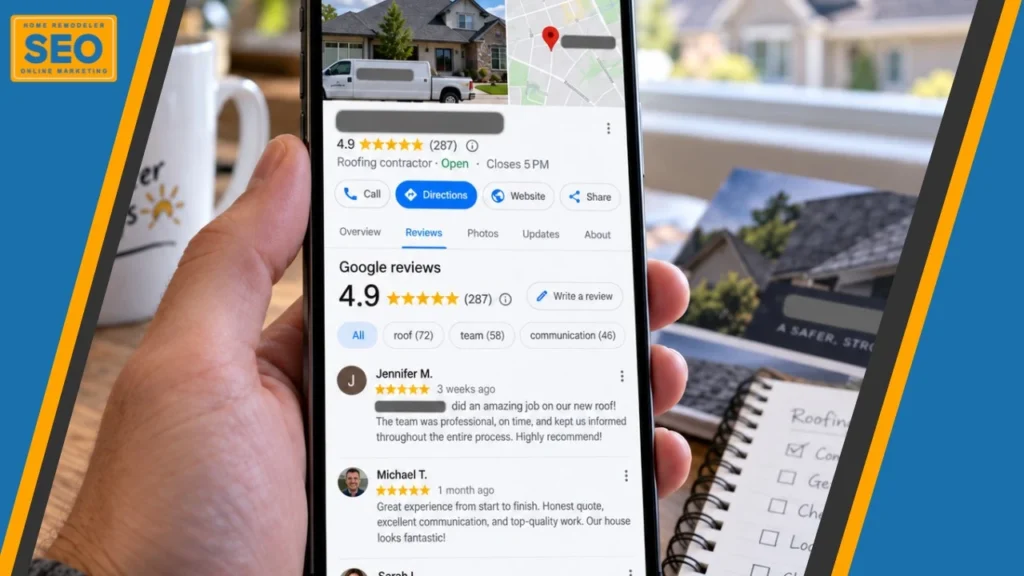
Contractor reviews SEO in 2026 comes down to four things homeowners and AI tools both notice: how recent your reviews are, which themes repeat across them, how many sites they appear on, and how quickly and personally you reply. A steady flow of fresh reviews across several platforms now carries more weight than a large pile collected years ago. How you ask for reviews matters too, because some common setups break Google's rules.
Put simply, contractor reviews SEO is managing customer reviews so they strengthen both your local SEO and the way AI tools describe your company.
Do Old Reviews Still Count? Why Recency Now Outweighs Your Total
Older reviews still count toward your rating. They just persuade far fewer people.
Homeowners have narrowed the window of reviews they trust. In BrightLocal's 2026 Local Consumer Review Survey, 74% of consumers said they only care about reviews from the last three months, and 32% look only at the last two weeks, up from 20% a year earlier.
For a remodeler who finishes a handful of large projects a month, that can feel discouraging. It shouldn't. Consistency matters more than volume.
The practical fix is to ask at the same moment on every job, such as the final walkthrough or punch-list sign-off. Two or three reviews arriving every month tell homeowners and AI tools that your company is active, busy and trusted right now.
What AI Review Summaries Say About Your Company
Google now uses its Gemini AI to condense reviews into short summaries on Maps and in Search. Google describes these review summaries as capturing the top themes from user reviews.
BrightLocal found 82% of consumers read AI-generated review summaries, and 23% would make a decision from the summary alone.
That changes what a single complaint can do. If three reviews mention a crew leaving debris in the driveway, the summary may say "some customers mention cleanup issues." That line can become the first thing a homeowner reads about you, ahead of fifty compliments about craftsmanship.
Here is a simple way to check your own summary:
- Open your listing in Google Maps on your phone and read the review highlights near the top.
- Ask ChatGPT and Gemini something like "What do customers say about Summit Remodeling in Charlotte?" using your own name and city.
- Write down the three themes that keep coming up, good and bad.
Then fix the bad ones on the job site, not in your marketing. If communication shows up as a weakness, a Friday update text from each project manager will do more than any reply you write. If cleanup is the issue, an end-of-day checklist changes what next month's reviews say. AI summaries reflect patterns, and only operations can change a pattern.
Where Else Do Your Reviews Need to Be?
Google is still the biggest review source, but its lead is shrinking. BrightLocal found Google's share as a review source fell from 83% to 71% in a year, while Apple Maps nearly doubled, from 14% to 27%. The average consumer now checks six review sites, and 45% have used ChatGPT or another AI tool for local recommendations, up from 6%.
Other AI tools may draw on different data than Google. When Whitespark studied Bing Places listings, which ChatGPT has historically leaned on for local answers, Facebook was the review source attached to businesses most often. Porch, Yellowpages and Angi also showed up regularly. Whether ChatGPT relies more on Bing or Google data is still debated, so treat this as evidence, not a rule.
The practical takeaway: a contractor with 200 Google reviews and an empty Facebook page may look thinner to some AI tools than the owner expects. Keep Google strong, then pick one or two other sites that matter in your trade and keep them active.
How Fast Should a Contractor Respond to Reviews?
Replies are visible to homeowners and to the AI tools summarizing your profile. BrightLocal found 89% of consumers expect owners to respond to reviews, and 19% now expect a same-day reply, up from 6% last year. Half are put off by templated responses.
No AI platform says replies directly earn recommendations. But replies are public text that homeowners, and the tools summarizing your profile, can read.
Here is a routine a busy owner can keep in about 15 minutes, twice a week:
- Monday and Thursday: check Google, Facebook and your secondary site.
- Reply to every new review, positive or negative.
- Mention the project, such as "glad the bathroom came together before your daughter's visit." Specific replies read as a real person running a real company.
- For a complaint, acknowledge it, give a name and a direct number, and move the conversation offline.
Is Your Review Request Process Legal?
The FTC's Consumer Reviews and Testimonials Rule, in effect since October 2024, bans incentives tied to positive reviews, fake reviews, and undisclosed reviews from employees or relatives. Penalties can reach $53,088 per violation. In December 2025, the FTC sent warning letters to ten companies, signaling that enforcement has started.
Then there is review gating: asking customers how they felt first and sending only the happy ones to a public review site. Google's review policy prohibits selectively soliciting positive reviews outright. The FTC says its rule doesn't specifically ban the practice, but that it could still violate federal law.
Many automated text funnels work exactly this way. Run a quick check of your own process:
- Does your request ask "How did we do?" and send only 4- and 5-star answers to Google?
- Do you offer a discount, gift card or raffle entry for reviews? Google bans any incentive, even a neutral one.
- Have employees or family members posted reviews without saying who they are?
The safe setup is one neutral rule: every customer gets the same public review request when the project is complete. A private feedback form is fine as an addition, never as a replacement.
How Many Reviews Do You Need to Show Up in AI?
There is no confirmed number. Some marketers promote fixed thresholds, but no AI provider has published one.
What the evidence does support is the combination above: recent reviews, detailed reviews, a presence beyond one site, and consistent replies. Reviews also still support traditional local SEO, since Google confirms that review count and score factor into local ranking. A contractor with 40 recent, detailed reviews across Google and one other trusted site often gives AI more to work with than one with 300 reviews that stopped arriving last year.

Frequently Asked Questions
Do old Google reviews still help my contracting business?
They still count toward your star rating, but most homeowners focus on the last three months. Recent reviews show you're still doing good work today.
Can I offer a discount for leaving a review?
Not on Google, which prohibits incentives of any kind. Under the FTC rule, any incentive tied to a positive review is illegal on every platform.
Does ChatGPT use Google reviews?
It's not fully settled. Research suggests ChatGPT has leaned on Bing data, where Facebook, Angi and Porch reviews appear often. Building reviews on more than one platform covers both possibilities.
How often should a remodeler ask for reviews?
After every completed project, with the same request for every customer. That keeps your profile fresh without screening anyone out.
A Clear Next Step
Many homeowners plan spring remodels over the winter. When they start comparing contractors, most will only look at reviews from the last three months. That means the reviews you collect between now and the holidays are the ones they'll actually read.
Waiting doesn't pause anything. A review request that only reaches happy customers, or a complaint theme nobody has addressed, keeps shaping your AI summary every week it runs.
A consultation with Home Remodeler SEO is a low-risk way to find out where you stand. We will check your Google review summary, the review sites where you're missing, and whether your request process follows Google's rules. You'll leave with the one or two changes worth making first, and no obligation to do anything more.


